The Tadpole Galaxy: A Cosmic Collision Frozen in Time
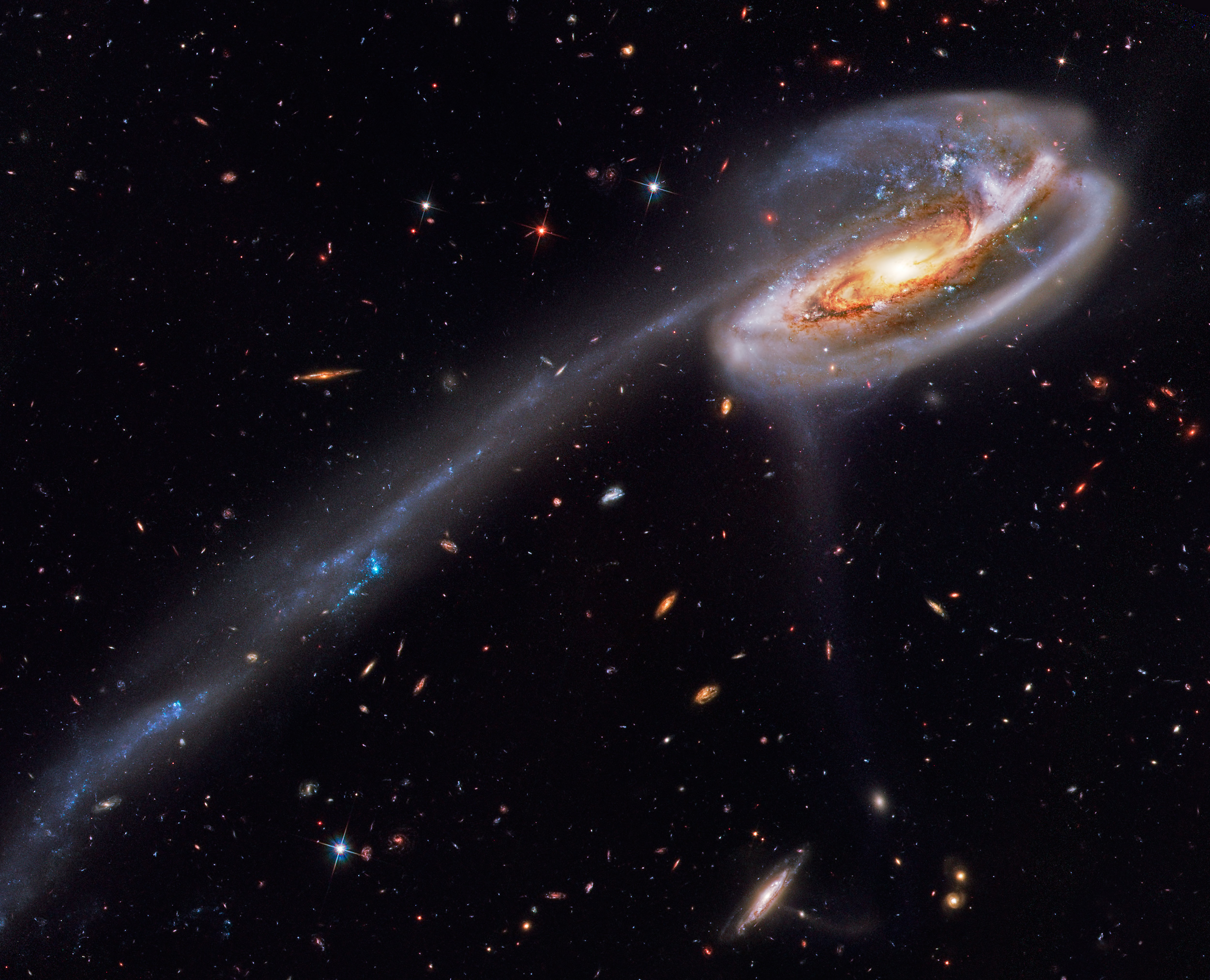
Swimming through the cosmic ocean of deep space, 420 million light-years away in the constellation Draco, lies one of the universe's most visually striking galaxies. The Tadpole Galaxy (officially designated UGC 10214) earned its whimsical name from its remarkable appearance: a disrupted spiral galaxy with a spectacular tail of stars stretching across 280,000 light-years of space—about 2.5 times the diameter of our entire Milky Way!
Anatomy of a Cosmic Tadpole
The Tadpole Galaxy is a barred spiral galaxy that has been dramatically transformed by a close encounter with another galaxy. Its distinctive features include a bright, compact core and that magnificent tail, which curves gracefully away from the main body of the galaxy. This tail isn't just a visual flourish—it's a stellar stream containing billions of stars, star clusters, and vast clouds of gas and dust.
The Great Galactic Encounter
About 100 million years ago, a smaller, more compact galaxy came too close to what would become the Tadpole Galaxy. The intruder, likely a blue compact galaxy, passed by and gravitationally punched through the larger galaxy's disk. This cosmic collision didn't destroy either galaxy, but it did set in motion a spectacular gravitational dance.
As the smaller galaxy passed through, tidal forces—the same type that cause ocean tides on Earth but on a galactic scale—pulled stars, gas, and dust out of the larger galaxy, creating the distinctive tail. The gravitational encounter compressed gas clouds, triggering intense bursts of star formation. Today, the tail glows with bright blue knots of newly formed stars, cosmic nurseries born from the violence of the collision.
Where Did the Intruder Go?
Eagle-eyed observers studying Hubble Space Telescope images have spotted the culprit! The smaller galaxy that caused this cosmic disruption can be seen about 300,000 light-years behind the Tadpole, appearing as a compact blue object. Having passed through its larger neighbor, it continues on its journey through space, leaving behind the beautiful chaos it created.
A Glimpse of Our Future?
The Tadpole Galaxy offers more than just beauty—it provides scientists with a laboratory to study galactic interactions and evolution. These types of collisions aren't rare in cosmic history. In fact, our own Milky Way is on a collision course with the Andromeda Galaxy, expected to interact in about 4 billion years. The Tadpole shows us what such encounters can look like and how they drive galactic evolution.
The Fate of the Tail
Over hundreds of millions of years, the tail will gradually disperse and much of its material will fall back into the main galaxy. Some of the stars may escape entirely, becoming orphaned in intergalactic space. Eventually, the Tadpole Galaxy will settle into a new equilibrium, perhaps resembling a more conventional elliptical galaxy, with its tail absorbed or scattered—a cosmic reminder that even galaxies are dynamic, ever-changing entities.
The Tadpole Galaxy stands as a monument to the dynamic, violent, yet ultimately creative nature of the universe. It reminds us that galaxies are not static islands in space, but evolving systems that grow, interact, and transform over cosmic timescales, painting new patterns across the canvas of the universe.