Gaia: Mapping Our Galaxy in Unprecedented Detail
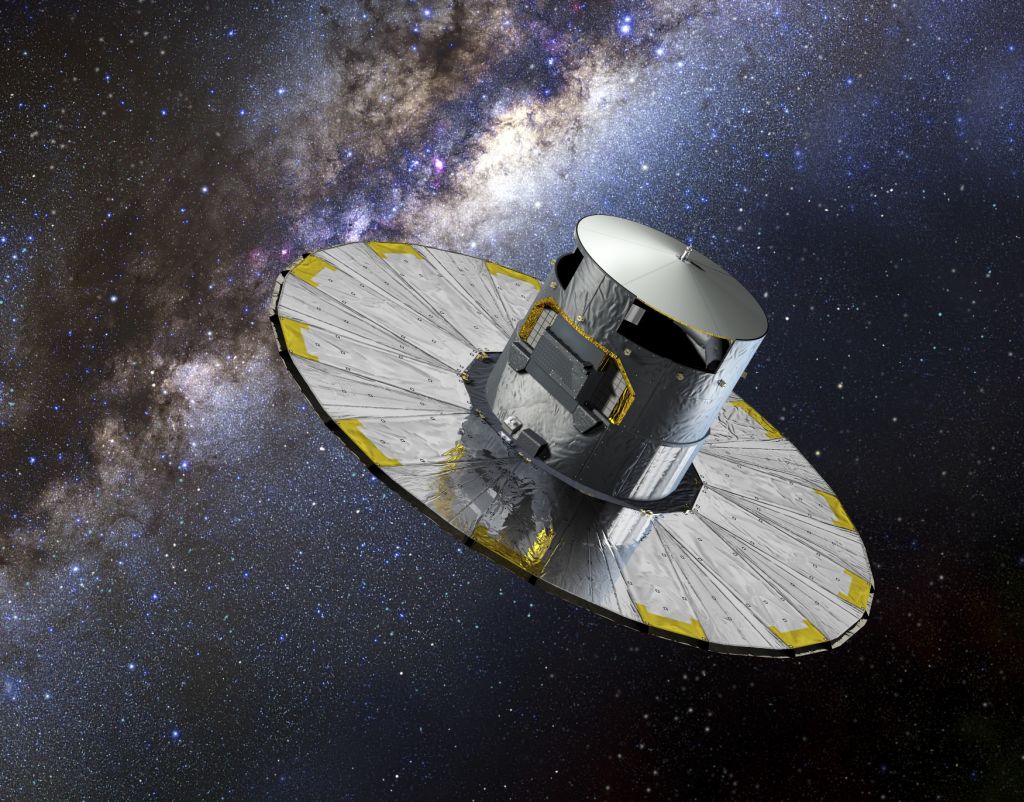
The Gaia space probe, launched by the European Space Agency (ESA) in December 2013, is on an extraordinary mission: to create the most accurate three-dimensional map of our Milky Way galaxy ever made. This celestial cartographer is revolutionizing our understanding of galactic structure, stellar evolution, and the dynamics of our cosmic neighborhood.
A Billion Star Survey
Gaia's primary goal is to measure the precise positions, distances, and motions of over one billion stars—roughly 1% of all the stars in our galaxy. By tracking these stars with unprecedented accuracy, Gaia is revealing the true nature of the Milky Way: how it formed, how it's structured, and how it's evolving over time.
Precision Beyond Imagination
The level of precision Gaia achieves is almost incomprehensible. The spacecraft can measure stellar positions to within 20 microarcseconds—that's equivalent to measuring the diameter of a human hair from 1,000 kilometers away! This extraordinary accuracy allows astronomers to calculate distances to stars with unprecedented reliability.
More Than Just Stars
While stars are Gaia's primary focus, the mission has expanded our knowledge in numerous ways:
- Asteroids: Discovered and tracked thousands of asteroids in our solar system, improving our understanding of near-Earth objects
- Exoplanets: Detected exoplanets through precise measurements of stellar wobbles caused by orbiting planets
- Quasars: Observed distant quasars to establish a precise reference frame for the entire celestial coordinate system
- Dark Matter: Helped trace the distribution of dark matter in the galaxy through gravitational effects on stellar motions
Data Releases: Gifts to Astronomy
Gaia has released multiple data catalogs, each more comprehensive than the last. The Data Release 3 (DR3), published in 2022, included detailed information on nearly 2 billion stars, including chemical compositions, temperatures, masses, ages, and radial velocities. This treasure trove of data will keep astronomers busy for decades.
Uncovering Galactic History
One of Gaia's most exciting contributions is revealing the turbulent history of the Milky Way. By analyzing stellar motions, scientists have discovered evidence of ancient galactic collisions and mergers, showing that our galaxy has grown over billions of years by absorbing smaller galaxies. These cosmic archeological findings are rewriting the story of our galactic home.
As Gaia continues its mission, spinning slowly in space at the L2 Lagrange point, it reminds us that sometimes the most profound discoveries come not from looking outward to distant galaxies, but from understanding our own cosmic backyard with exquisite detail. The Gaia mission is creating a legacy dataset that will serve generations of astronomers to come.